Having consistent ways to talk about decent homes works to deepen people’s understanding and build support for the changes we know can make a big difference in people’s lives. This quick guide gives you all the elements you need to make your communications more effective. You can also learn more about the research and thinking behind this guidance here, and find case studies of what it looks like in practice here.

Use these messages in your communications 

Quick Guide

Message

Why this works

Message

“A decent home is warm, dry, accessible, and offers security of tenure.  Decent homes allow people to contribute to and participate in our communities.  They allow people to get work and get to work and to keep kids in school.  Decent homes keep people healthy.” 

Why this works

This is a public good narrative. It surfaces values to do with social justice, self-direction, responsibility 
and care.

Message

“Our homes need to look after us at every stage and circumstance of life: from newborn babies to grandparents/ kaumatua; when we are well and when we are sick.  Homes can be the safe haven everyone deserves.”

Why this works

This is a public good / equity narrative, that surfaces values to do with care and responsibility. 

Message

“Imagine if… everyone in New Zealand had a place to come home to where they could be comfortable and warm and breathe easy.”

Why this works

This is an equity narrative. It could be paired with a better together or a systems narrative, which would sound like: ‘the way to this is through collective action’/ ‘the way to this is through systems change.’ It surfaces values to do with social justice, and equality, and it encourages feelings of hope. 

Message

“We have the knowledge and capabilities to ensure every New Zealander can feel at home in their home.” 

Why this works

This is a strengths-based / equity narrative which surfaces values to do with self-direction and wisdom.

Message

“When our homes are healthy, dry and comfortable, we can live full lives and give back to our communities.”  

Why this works

This is another public good / systems narrative, that surfaces values to do with responsibility, care, and equality. 

Message

“As New Zealanders we value fairness and the opportunity for everyone to live in a decent home. The current state of our housing means many – usually the most vulnerable – are locked out of those choices.”

Why this works

This is an equity / systems narrative, which surfaces values to do with equality, self-direction, and social justice. 

Focus on people who are open to understanding and persuasion 

Your audience can be broken into three groups.

Supporters – they play an important role in reaching people who are open to understanding and persuasion.

Persuadables — people who haven’t thought much about or don’t hold a strong view on decent homes.

Opposition — people who hold strong views that oppose your work or 
your solutions.

Structure your stories 
to make them easy to understand 

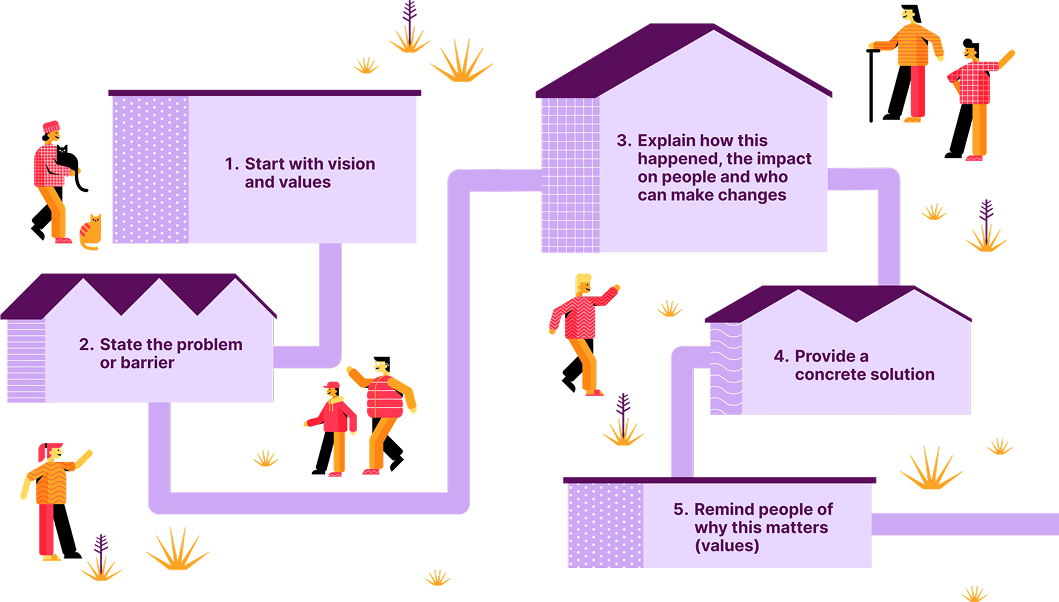
The order we present information matters. This story structure works with fast-thinking brains, making them easy to understand and engage with.

Guide System
1

1. Start with vision 
and values

The vision is a concrete description of the better world we experience once changes have been made.

Values are our deep motivations, reminding people why decent homes are important helps them connect with the story.

2
2. State the problem 
or barrier

Clearly state what is getting in the way of all people having access to decent homes. The vision is a concrete description of the better world we experience once changes have been made.

3
3. Explain how this happened, the impact on people and who can make changes

Your explanation needs to step people through the issue so people understand. You can use metaphors and select facts in your explanation. Name the people and organsiations who can make change.

4
4. Provide a concrete solution 

Your solution should match your barrier in size and scale and follow logically from your explanation. Be as specific as possible.

5
5. Remind people of why this matters (values) 

End with reminding people why we care about this by using values.

Embrace words that surface helpful thinking 

The words we choose act as pre-packaged explanations about how the world works. They can bring to the surface particular ways of thinking about an issue. Embrace words and frames that lead to helpful thinking. 

Avoid

Embrace

Avoid

Housing as a market as this primes people to think only about homes in financial terms and makes it hard to see that people and decision makers can make changes. 

Embrace

Decent homes as infrastructure for care, connection and contribution.

Avoid

Housing as an asset as this primes people to think only in financial terms and limits solutions and actions that have other benefits.

Embrace

Homes have a job to do – keep us all warm or cool, dry, safe, healthy – enable us all to care, connect and contribute.

Avoid

Decent homes as a trade-off or preference for some as this primes othering or us vs them thinking. 

Embrace

Decent homes lead to downstream improvements in health, education, employment, community engagement. 

Avoid

High-performance homes as this primes people to see homes that do their job as a luxury not an essential foundation for life.

Embrace

Homes that meet our real needs.

Avoid

Affordability as this primes people to think in financial terms and limits solutions and actions that have other benefits. 

Embrace

Homes that are available to everyone regardless of income (could also include age and location to broaden idea of availability).

Avoid

The economy as an organic or independent entity.

Embrace

The economy is designed by people and can be redesigned.

Avoid these traps that undermine your communications 

Some common habits can work to undermine the effectiveness of your communications, these are common traps to avoid: